
The Heritage & Philosophy Behind Testwin
The Story Behind the Image
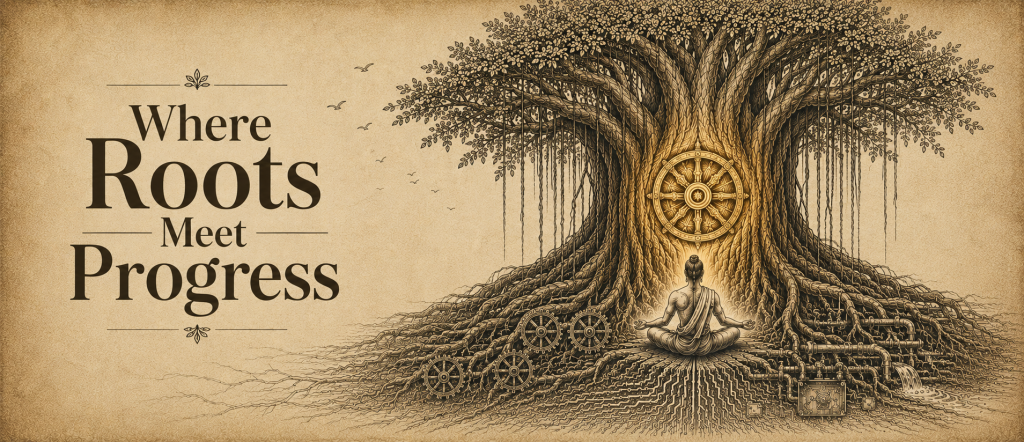
Where Roots Meet Progress
At the center of this illustration stands an ancient banyan tree — a symbol long used in Indian thought to represent dharma: the underlying order, duty, and integrity that a life or an institution is meant to grow from. Carved into its trunk is a glowing wheel, the dharmachakra, representing purpose in motion — action guided by principle rather than by impulse.
From the base of the tree, the roots do something unusual: they transform. What begins as natural root fiber gradually becomes gears, circuit lines, and irrigation channels — technology and enterprise (artha) shown not as separate from tradition, but as something that grows directly out of it. This reflects a core idea in classical Indian philosophy: wealth, industry, and technical progress are not in conflict with ethical foundation — they are meant to be rooted in it.
Seated at the base of the tree is a single figure in quiet meditation, hands open rather than grasping — a reference to nishkama karma, the principle of doing one’s work with full commitment and excellence, without being driven by ego or anxious attachment to outcome. It’s a reminder that skill and diligence, not shortcuts, are what sustain lasting work.
Together, the image tells a simple story: real progress isn’t something bolted onto a foundation after the fact. It grows out of one — the same way precision, reliability, and trust have to be built into work from the ground up, not added as an afterthought.
For Testwin Apparatus Marketing Service, this image is a visual reminder of what we believe: that technical excellence in testing and measurement only means something when it’s built on a foundation of integrity, patience, and care — the same values this old tree has always stood for.
Why heritage-building oil paintings, across every page
Each page needs a different job — home, about, products, service, contact, articles — but the same visual grammar of oil-painting portraits of Indian scholars makes them read as one connected story instead of six disconnected pages.
- One idea per page: Aryabhata’s zero (Home), the ancient astronomers and Chandrayaan (About), Sushruta’s surgery (Product), Pingala’s mathematics (Service), Nalanda’s dialogue (Contact), Raman and Bose (Article), each paired with that page’s specific purpose.
- Precision becomes lineage, not slogan: the history carries the credibility, so the copy doesn’t have to oversell it.
- Painting signals story, photography signals proof: it separates identity pages from capability pages without needing a label.
- Spreads the weight: six different references, instead of one big ISRO comparison, keeps each reference light and credible.
- Distinct and hard to copy: real historical figures, not stock imagery or a single hero shot, give Testwin its own visual identity.
Home Page —
The Story Behind the Image
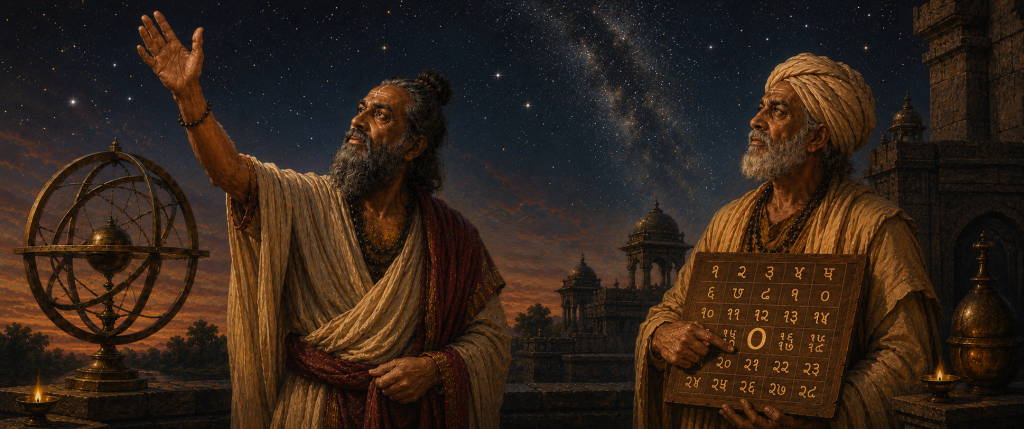
Aryabhata & Brahmagupta
Where Precision Began
The birth of zero, the foundation of every measurement we make today.
Two scholars stand on an observatory terrace under a night sky. One reaches toward the stars; the other holds a numbered tablet, pointing at a glowing zero. One idea unites them: observing the universe and the mathematics that makes it measurable are the same pursuit.
Why It Fits Testwin
Zero is the origin of measurement — every scale, calibration, and test starts from a reference point, making it the perfect symbol for “foundation of precision.”
The two figures reflect real intellectual lineage: Aryabhata (b. 476 CE) advanced Indian astronomy and place-value thinking, while Brahmagupta (b. 598 CE) gave the earliest surviving formal rules for arithmetic with zero in his Brahmasphutasiddhanta (628 CE). Together they show rigour passed across generations — a value any credible testing organisation wants to signal.
This heritage builds trust: precision isn’t a recent invention. Anchoring the brand in centuries-old observation and calculation suggests depth and continuity, not a passing trend.
The stars and armillary sphere represent observation; the tablet represents calculation. Testwin’s work depends on both — collecting data faithfully and interpreting it exactly. The caption, “Between the stars and the number line, they gave the world zero,” names this bridge directly.
The warm lamplight against a star-filled sky creates a calm, contemplative mood — patience and accuracy over haste, fitting a brand promising reliable results.
About Testwin —
The Story Behind the Image
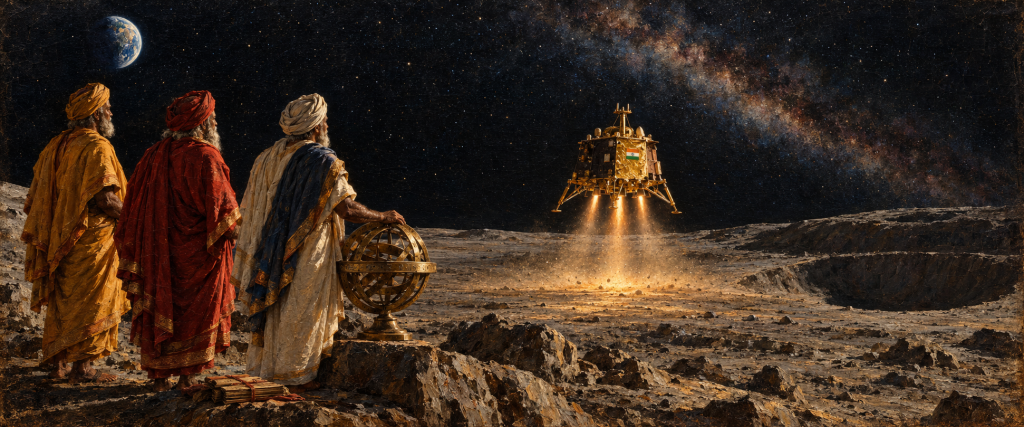
ISRO (Chandrayaan/Mangalyaan)
A Young Company, A Limitless Ambition
From ancient stargazers to Mars and the Moon — the sky was never the limit.
This isn’t a claim of equality with ISRO — it’s a shared spirit. Testwin, founded in 2020, is a young company already meeting international precision standards, and the painting borrows the feeling of that national moment: ambition, discipline, progress against odds.
The two figures aren’t unrelated subjects — they’re two eras of one pursuit. The ancient astronomer-scholars with their armillary sphere and palm-leaf manuscript represent India’s long relationship with precision measurement, from Aryabhata and Brahmagupta to the Jantar Mantar tradition. The lander shows where that same instinct has arrived today. One frame, one argument: this isn’t a new impulse — it’s an old one, freshly delivered. Only an Indian company can credibly make that claim.
It also reframes “testing and precision” as lineage, not service — the armillary sphere literally is an ancient measurement instrument, so the visual rhyme explains itself.
The caption — “From ancient stargazers to Mars and the Moon — the sky was never the limit” — names both eras and states the through-line explicitly.
Finally, unlike the site’s other pages (services, lab, support), which use photography to prove present-day capability, the About page uses a painting to signal heritage and spirit — helping visitors distinguish brand story from service credibility at a glance.
Product Page —
The Story Behind the Image
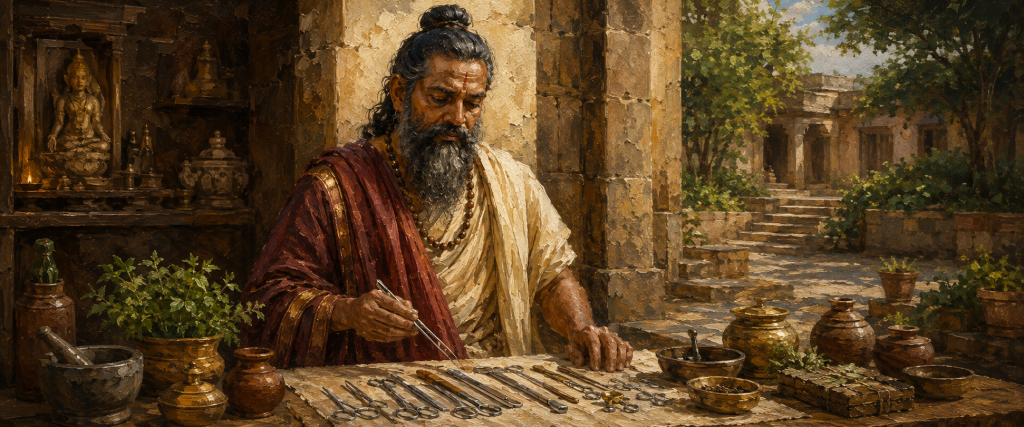
Sushruta
Instruments Built to Heal, Engineered to Endure
The father of surgery and the origin of precision tools
Sushruta, the ancient Indian physician often called the “father of surgery,” is traditionally associated with the Sushruta Samhita, one of the foundational texts of Ayurvedic medicine. His exact dates are uncertain. Tradition links him to the sage Dhanvantari and to Varanasi, and scholars generally place the origins of the text somewhere between the 6th century BCE and the early centuries CE. The work we have today was compiled and revised over time, and its present form is often associated with later editors such as Nagarjuna.
The Sushruta Samhita is remarkable for its practical detail. It describes surgical procedures, including the removal of stones, the repair of wounds and fractures, and reconstructive techniques such as rebuilding the nose with a skin flap, which is why many historians of medicine regard him as a pioneer of plastic surgery. The text lists around 120 surgical instruments, including scalpels, forceps, probes, needles and specula, and it gives guidance on making them: they should be sharp, well-finished, properly sized and kept in good condition. It also stresses cleanliness, careful handling and long, disciplined training, with students practising on fruits, leaves and models before ever operating on a patient.
Modern scholars value the text as a rich record of early surgical knowledge, while noting that its dating and authorship are debated, and that later layers were added by commentators and editors.
Why does this matter to Testwin? Because Sushruta’s central belief was that a tool is only as trustworthy as the care taken in making it, and that even the smallest error carries real consequence. The same is true of testing and measurement. When a reading decides whether a material is safe or a part is fit for use, accuracy is not a luxury.
Every instrument we offer follows this principle: precision engineered, carefully calibrated and tested to exacting standards before it reaches you. Sushruta’s instruments served healing; ours serve confidence in the numbers that engineers, laboratories and industries depend on.
The painting captures this spirit well. Finely crafted tools laid out in deliberate order, a quiet courtyard and nothing rushed or accidental. The oil medium gives metal, stone and fabric a tangible, solid presence, just as we want our products to feel: dependable, tested and trustworthy.
Sushruta’s hands healed with instruments of mastery; ours measure with the same unwavering standard.
Service Page —
The Story Behind the Image

Pingala
The Hidden Mathematics of Discipline
Centuries before binary code, Pingala found rhythm in patterns — we find precision in process
Rishi Pingala, the ancient Indian scholar behind the Chandaḥśāstra, the earliest surviving treatise on Sanskrit prosody, is traditionally regarded as the younger brother, or a close relative, of the grammarian Pāṇini. His exact dates are uncertain. He is traditionally placed between the 3rd and 2nd century BCE, though some traditions place him earlier.
To classify the rhythm of Sanskrit verse, Pingala described every possible pattern of short (laghu) and long (guru) syllables. In doing so, he used an early binary-style system, centuries before binary code existed. His rules for counting and indexing these patterns show remarkable sophistication, and they anticipated ideas later known as combinatorics, the Fibonacci sequence and the Meru Prastāra, the number arrangement now called Pascal’s Triangle. A poet studying rhythm had, in effect, uncovered mathematical structure that others had overlooked.
Modern historians of mathematics recognise Pingala as a pioneer of combinatorial thinking. Scholars such as Datta and Singh regard his work as an early, sophisticated treatment of permutations and combinations, and Donald Knuth has noted that Indian prosodists were counting rhythmic patterns long before Fibonacci’s time. Fields Medalist Manjul Bhargava has also spoken publicly about how Sanskrit prosody led Indian scholars to sequences and combinatorics well before European mathematicians. Historians are careful, however, to note that “binary” is a modern comparison, since Pingala used short and long markers to enumerate patterns rather than to perform arithmetic. They also point out that later commentators, such as Halāyudha in the 10th century CE, explained and developed many of these ideas more fully.
His lesson is simple: consistency and systematic thinking reveal truths invisible to the casual eye.
That is the discipline behind our service at Testwin. Every calibration, every maintenance visit and every client interaction follows a structured, repeatable method, because reliability isn’t accidental; it is built through process. When procedure is clear, results are dependable, and clients can trust every measurement we stand behind.
Pingala found order within rhythm. We find precision within procedure.
Article Page —
The Story Behind the Image
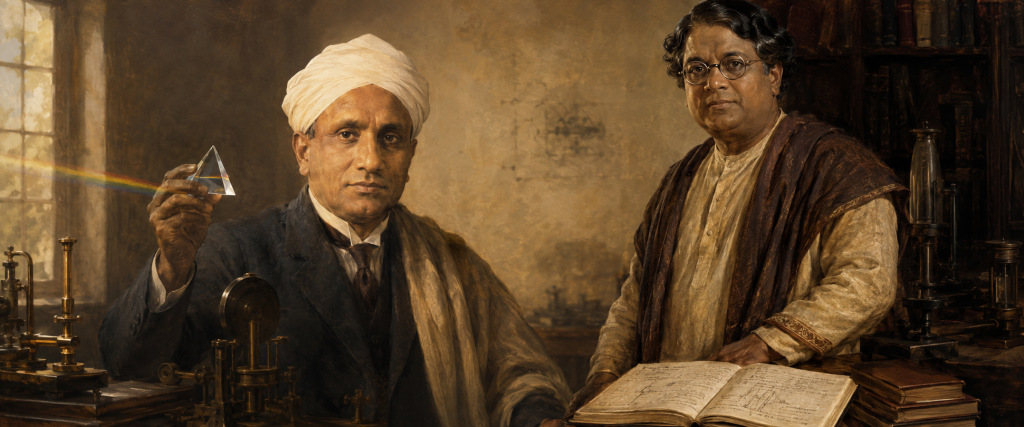
C.V. Raman & S.N. Bose
Knowledge Shared, Discovery Multiplied
India’s first steps onto science’s world stage — carried forward through every idea we share
Sir C.V. Raman and Satyendra Nath Bose were among the most influential Indian scientists of the twentieth century. Raman’s work on the scattering of light earned him the 1930 Nobel Prize in Physics, while Bose’s ideas on quantum statistics helped shape modern physics. We feature them on our Articles Page because our articles exist for the same purpose their work served: sharing knowledge. Both men valued curiosity, careful observation and the open exchange of ideas, and their discoveries remind us that sound science begins with accurate measurement.
The painting captures this spirit with quiet dignity. Raman holds a glass prism while a ray of light splits into colour, and Bose stands beside an open notebook, surrounded by books. Brass laboratory instruments, the classic tools of experiment and precision, complete the scene. We chose oil as the medium deliberately. Its layered brushwork and warm, earthy tones lend the image a scholarly depth, suit a subject rooted in heritage, and feel more considered and personal than a stock photograph.
For our readers, the promise is clear: well-researched articles, practical insight into testing and calibration, and knowledge shared with the generosity that defined Indian science.
Contact Page —
The Story Behind the Image
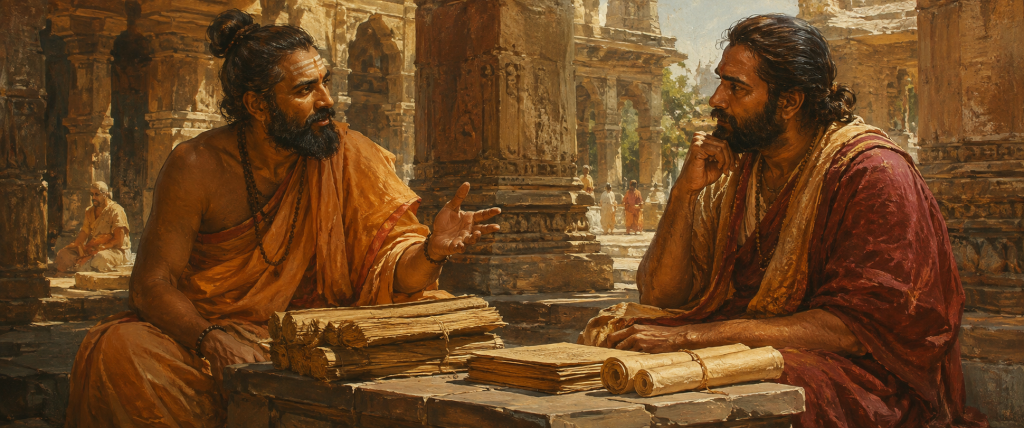
“Echoes of Nalanda”
Every Connection Begins Somewhere
Two scholars are discussing in the “Nalanda”
Nalanda was one of the ancient world’s great centers of learning, a place where scholars gathered to question, listen and refine their understanding through conversation. We feature two of them on our Contact Page because every worthwhile working relationship begins the same way: with a genuine exchange of ideas. Whether you have a technical query, a calibration requirement or a project to discuss, we approach your message in that spirit, with attention, clarity and respect for your questions.
Many institutions are remembered for what they taught. Nalanda is remembered for how it taught. Its scholars studied through debate and open discussion, and students travelled from across Asia to take part, making it a lasting symbol of connection across distance. That is precisely what a Contact Page is meant to offer. Nalanda also belongs to our own heritage, in keeping with the Indian scholars featured across our website, from Pingala to Sushruta, Raman and Bose. Other great universities represent excellence, but Nalanda represents conversation, and conversation is where our work with you begins.
The painting brings this to life. One scholar gestures as he explains a point, while the other rests his chin on his hand, considering it carefully. Palm-leaf manuscripts and scrolls lie between them on a stone table, set within the sunlit courtyards of Nalanda. We chose oil as the medium because its rich, textured strokes and warm, golden tones give the scene a human presence and a sense of lasting value. It feels personal and thoughtful, qualities a stock photograph rarely captures, and they are the qualities we hope you find when you contact us.
An explanation of the cover photo on the Contact page—-

Rooted in Listening
At first glance, this photograph captures a quiet meeting between a modern Indian professional and a Rishi beneath an ancient banyan tree.
But the image speaks to something far more timeless: the difference between reaching someone and truly connecting with them.
The woman represents the modern world—professional, contemporary and connected through technology, yet deeply rooted in her cultural heritage. The Rishi represents wisdom, experience and an enduring Indian tradition of learning through presence, listening and personal exchange.
Between them, a small diya burns quietly.
Its light symbolizes the warmth of genuine human connection—not something loud or spectacular, but a shared light that emerges when two people are willing to listen, understand and engage with one another.
The cool, distant light on the left reflects our digital world: vast networks, instant messages and the ability to reach almost anyone within moments.
Yet reach is not the same as connection.
Connection asks for something more.
It asks for attention.
For understanding.
For trust.
The warmth of the golden light reminds us that meaningful relationships are still built through human presence and human interaction.
The banyan tree, with its deep roots, enduring presence and sheltering form, reflects another simple truth: meaningful relationships, like meaningful knowledge, take time to grow.
Even the open space on the left has a purpose.
It is not simply space for the words Contact Us. It is an invitation—to pause, to reach out and to enter a conversation.
Before you fill out a form, send an enquiry, or begin a business discussion, we want you to feel that you have been received, not merely contacted.
Request Service & Support Page—
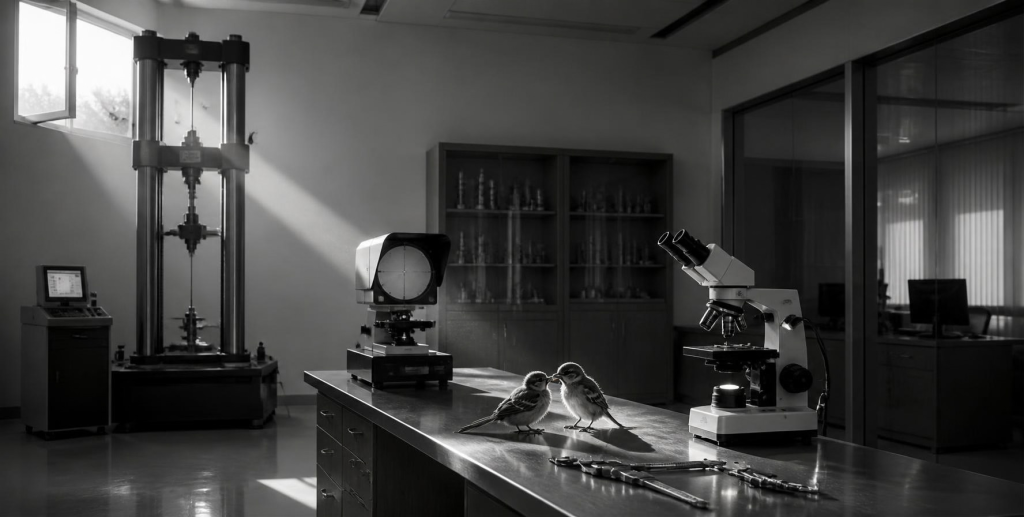
Detailed Explanation (for the “About the Banner Image”)
Understanding Our Banner
Our banner shows a materials testing laboratory in black and white, with two small sparrows standing on the laboratory bench. Every element in the image was chosen to express what we believe about our work and the people we serve.
The Two Sparrows: Cooperation and Care
The two sparrows stand face to face, their beaks almost touching. This gesture shows trust, closeness, and mutual support. One bird helps and comforts the other, and each is aware of the other’s feelings.
This is how we want to work with our customers. A service request is not just a technical task. Behind it is a person with a need, a deadline, or a concern. We listen, we understand, and we help, and in return we value the trust that customers place in us.
The sparrows are small and gentle, which reminds us to stay humble and approachable no matter how advanced our equipment is.
Black and White: Intensity and Depth of Emotion
We chose black and white deliberately. Without colour, nothing distracts from the feeling in the scene. Only light, shadow, and texture remain, and they bring out the intensity and depth of emotion.
The strong contrast between bright sunlight and deep shadow reflects the many layers of human feeling: hope and worry, urgency and patience, responsibility and trust. The monochrome style also gives the image a timeless and honest quality, just as we aim to be honest and dependable in our results.
The Light: Hope and Guidance
A beam of sunlight enters through the window and falls across the laboratory, leading the eye toward the sparrows. It stands for hope, warmth, and guidance. Just as light brings clarity to a dark room, our service brings clarity and confidence to our customers’ questions.
Machines and Living Beings: Technology with a Human Touch
Around the sparrows stand the tools of our laboratory:
- Universal Testing Machine, for testing the strength of materials
- Profile Projector, for accurate dimensional inspection
- Optical Microscope, for studying structure and surface details
- Vernier Calipers, for precise measurement
These represent accuracy, reliability, and technical strength. The soft, living sparrows placed among them show that precision and compassion belong together. Our laboratory combines technical excellence with human values.
Our Message to You
When you submit a service request, you are not simply sending a job to a system. You are reaching out to a team that listens, cares, and works together to support you.
Precision in every measurement, care in every service. Together, we support your needs.